 Technical & Quality
Understanding GSM, BF & ECT in Corrugated Packaging
When purchasing corrugated boxes, you may often hear terms such as 18 BF, 20 BF, 24 BF, 28 BF, or 35 BF. Many buyers assume that a higher BF…
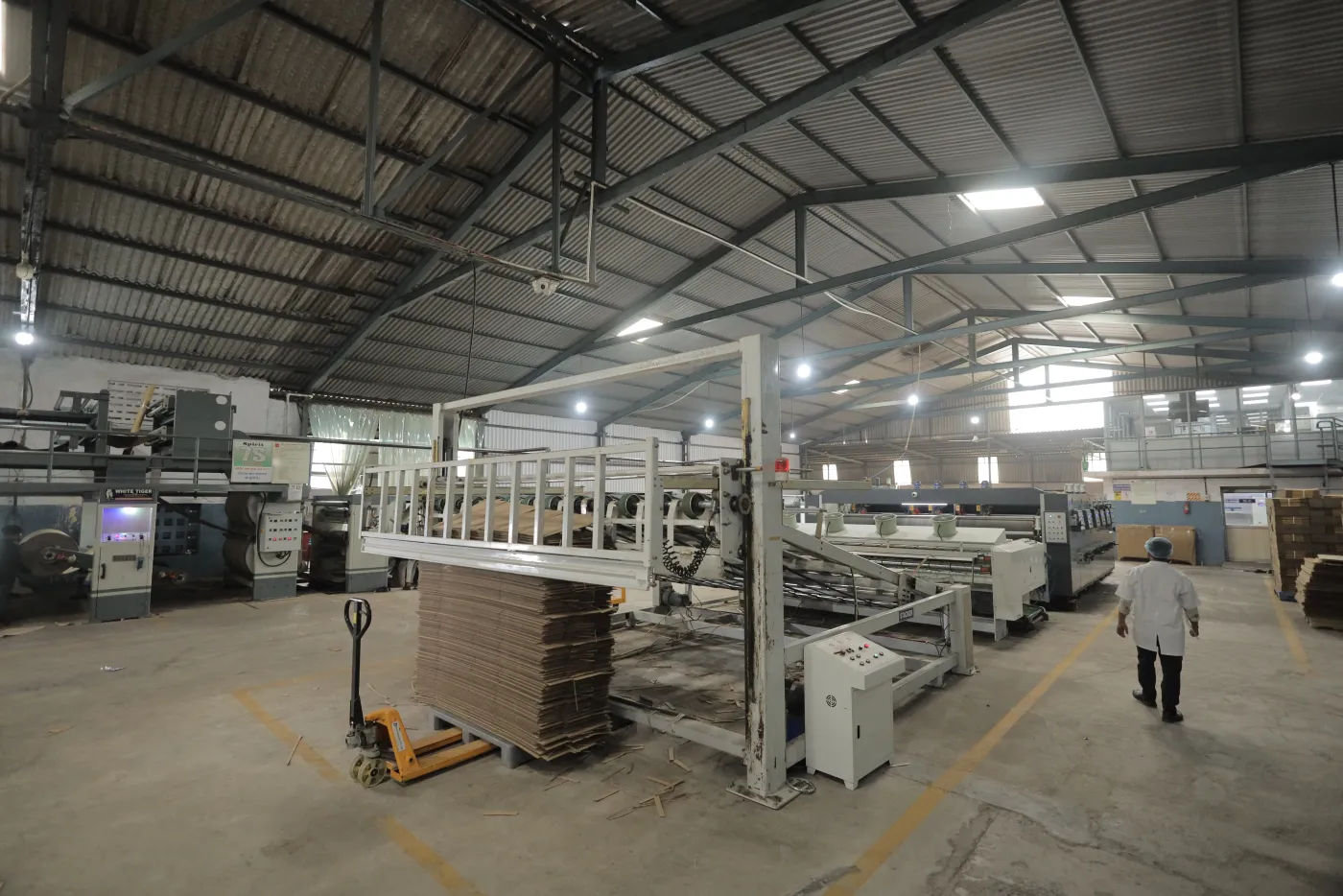
In today’s fast-moving supply chain, corrugated boxes are expected to withstand stacking in warehouses, transportation over long distances, and repeated handling before reaching the customer. While many buyers focus on GSM and Burst Factor (BF), another equally important quality parameter often goes unnoticed—the Edge Crush Test (ECT).
The Edge Crush Test (ECT) measures the strength of a corrugated board when force is applied to its edge. Since corrugated boxes are stacked vertically during storage and transportation, edge strength is one of the biggest factors determining whether a box will remain intact or collapse.
At Asian Packaging Industries, ECT is one of the key quality tests used to ensure our corrugated boxes meet the performance requirements of industries such as pharmaceuticals, FMCG, engineering, electronics, automotive, chemicals, textiles, and export packaging.
The Edge Crush Test (ECT) measures the amount of vertical compressive force a corrugated board can withstand before it buckles or crushes.
Unlike Burst Factor, which measures the strength of the paper itself, ECT evaluates the structural strength of the corrugated board.
The higher the ECT value, the stronger the board is when stacked vertically.
This makes ECT one of the most important indicators of how well a corrugated box will perform during warehousing and shipping.
During transportation and storage, corrugated boxes are rarely subjected to bursting pressure. Instead, they experience vertical loads created by stacking.
For example:
A board with a high ECT can withstand greater vertical pressure without collapsing.
Higher ECT results in:
ECT is carried out using a specialized Edge Crush Testing Machine.
A small corrugated board sample is cut to standard dimensions.
The sample is positioned vertically between two compression plates.
The testing machine gradually applies pressure to the edge of the sample.
The pressure continues until the board collapses.
The maximum force required to crush the board is recorded.
The result is generally expressed in:
Higher ECT values indicate stronger corrugated boards.
Generally:
| ECT Value | Packaging Performance |
|---|---|
| Low | Light-duty packaging |
| Medium | General shipping cartons |
| High | Industrial packaging |
| Very High | Heavy-duty export packaging |
The required ECT depends on the product, box dimensions, and stacking conditions.
Traditionally, many packaging buyers selected corrugated boxes based on Burst Factor.
However, today’s logistics systems place much greater emphasis on stacking strength.
Modern supply chains involve:
These conditions make ECT a better indicator of real-world packaging performance than Burst Factor alone.
Several factors influence the Edge Crush Test value.
The flute design plays a major role in edge strength.
Examples:
Double-wall flute combinations generally provide higher ECT values.
High-quality kraft paper with strong fibres improves board performance.
Proper bonding between liners and fluting is essential for maintaining edge strength.
Poor adhesion reduces ECT significantly.
Generally:
Uniform flute formation, correct pressure settings, and proper moisture control all improve ECT performance.
These two tests measure completely different properties.
| Edge Crush Test (ECT) | Burst Factor (BF) |
|---|---|
| Measures board strength | Measures paper strength |
| Tests corrugated board | Tests kraft paper |
| Important for stacking | Important for bursting resistance |
| Predicts box compression | Evaluates paper quality |
Both are important, but they should never be considered interchangeable.
Many people also confuse ECT with BCT.
| ECT | BCT |
|---|---|
| Tests corrugated board | Tests completed box |
| Measures edge strength | Measures box compression strength |
| Laboratory board test | Finished packaging test |
| Used during board selection | Used before commercial production |
ECT is one of the factors that contributes to a higher BCT value.
High ECT is especially important for:
Boxes remain stacked inside containers for extended periods.
Products stored on pallets require strong vertical support.
Engineering and automotive components generate higher stacking loads.
Packages experience repeated handling and stacking.
Products require stable packaging to prevent compression damage.
Several issues reduce edge strength.
Examples include:
Routine quality testing helps identify these issues before production.
Manufacturers can improve Edge Crush Test values by:
✔ Using stronger kraft paper.
✔ Selecting the correct flute profile.
✔ Improving adhesive quality.
✔ Choosing double-wall board construction when necessary.
✔ Maintaining proper moisture control.
✔ Using advanced corrugation equipment.
✔ Performing regular laboratory testing.
These improvements result in stronger and more reliable packaging.
Our packaging specialists recommend:
This approach provides better performance while controlling packaging costs.
At Asian Packaging Industries, every corrugated board is manufactured using carefully selected raw materials and tested to ensure excellent edge strength and packaging performance.
Our capabilities include:
Our technical experts help customers choose the right board construction and flute combination to maximize product protection while optimizing packaging costs.
ECT measures the amount of force required to crush the edge of a corrugated board. It is one of the most important indicators of stacking strength.
ECT helps determine whether a corrugated box can withstand stacking during storage, warehousing, and transportation.
They measure different properties. BF evaluates paper strength, while ECT evaluates board strength. For modern logistics and stacking performance, ECT often provides a better indication of real-world packaging performance.
Generally, yes. Higher ECT values improve the board’s ability to resist compression and contribute to stronger stacking performance.
Export packaging, engineering, automotive, electronics, pharmaceuticals, FMCG, and heavy industrial products commonly require boards with higher ECT values.
The Edge Crush Test (ECT) is one of the most valuable quality tests in corrugated packaging because it measures the structural strength of the corrugated board under vertical compression. Strong ECT values improve stacking performance, reduce transportation damage, and enhance the overall reliability of corrugated boxes.
At Asian Packaging Industries, we combine premium raw materials, advanced manufacturing technology, and rigorous quality testing to produce corrugated packaging that performs consistently under demanding storage and transportation conditions. By selecting the right combination of ECT, BCT, BF, GSM, flute profile, and board construction, we help our customers achieve durable, cost-effective, and reliable packaging solutions for every industry.
Need this specified for your own product?
Technical & QualityWhen purchasing corrugated boxes, you may often hear terms such as 18 BF, 20 BF, 24 BF, 28 BF, or 35 BF. Many buyers assume that a higher BF…
5 min read Technical & Quality
When purchasing corrugated boxes, you've probably come across specifications like 120 GSM, 150 GSM, 180 GSM, or 250 GSM. Many people assume that a…
5 min read Technical & Quality
When buying corrugated boxes, one of the most common questions customers ask is:
6 min read